The same RC can mean something different.
RC +8 with four decks left is about TC +2. With two decks left it is about TC +4. True Count adds shoe depth to the context; it does not promise a win.
INSIDE ADVANTAGE COUNT · v1 PRIVATE BETA
Skim the five parts of the product. Open only the tool you care about, then go deeper at your own pace.
RC +8 with four decks left is about TC +2. With two decks left it is about TC +4. True Count adds shoe depth to the context; it does not promise a win.
EV compares what actions are worth over many similar situations. It measures decision quality, not the result of the next card.
Stake sizing and forecasts show how much capital is exposed to variance. They cannot improve card order or make a bet safe.
FIVE PARTS OF THE PRODUCT
Read the practical guide for this tool →
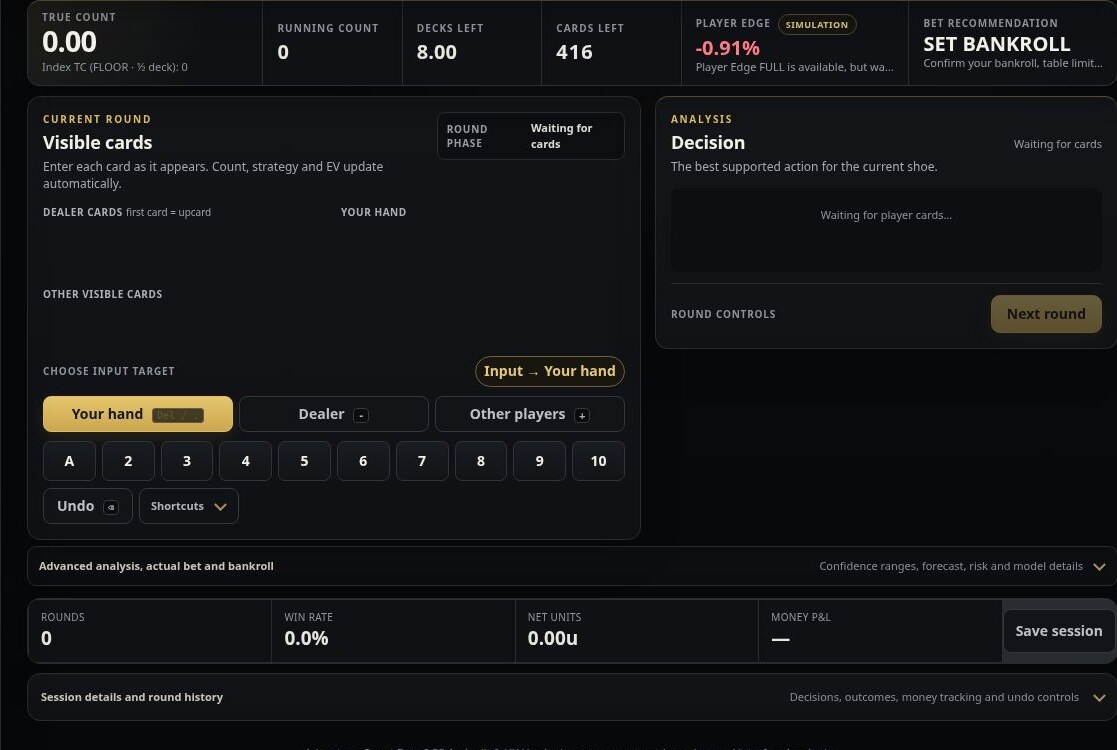
Add ranks A–10 to your hand, the dealer or other exposed seats.
Every visible card changes the remaining composition and the count used by later analysis.
Applies the Hi-Lo tags to every entered card.
Shows how the exposed cards have shifted the shoe before accounting for its remaining depth.
Normalizes Running Count by the estimated decks remaining and also shows the active index convention.
Makes the same Running Count comparable at different points in the shoe; it does not create a fixed guaranteed edge.
Choose automatic mode, a faster estimate or the deepest supported calculation.
You decide whether speed or calculation depth matters more, and the program still tells you which route it used.
Filters Hit, Stand, Double, Split, Resplit and Surrender through the active table rules before comparing them.
Prevents a mathematically attractive but illegal action from becoming the recommendation.
Places the default strategy beside the active count-based policy and its source.
Shows when a count-based deviation changes the default action and why.
Compares the long-run value of supported actions and labels the result EXACT, APPROX, SIMULATION or STRATEGY.
The label tells you how the answer was produced. EV compares decisions over time; it does not predict the next card.
Handles insurance choices plus peek, Ace-only peek and no-hole-card continuation gates.
Keeps the decision order consistent with the table procedure and dealer-blackjack exposure.
Tracks separate hands, mandatory draws, Double, Resplit and Split-Ace restrictions.
Lets the same rules and remaining shoe govern the full multi-hand decision.
Converts a live offer into the selected total-return or net-profit contract and compares it with continuing.
Treats variable Cash Out separately from surrender instead of assuming they are the same action.
Mirrors the round phase, best action and result quality on narrow screens.
Keeps the decision visible when the full desktop layout stacks vertically.
Supports single Undo, Undo 5, whole-round rewind and confirmed previous-round restore.
Makes input correction possible without silently rebuilding the shoe or session.
Simulates many complete rounds from the current shoe and selected rules before the next deal.
It estimates long-run conditions at this point in the shoe. It is not your chance of winning the next round.
Shows how uncertain the Player Edge estimate still is and how many simulated rounds support it.
A small positive estimate may still be noise. The range prevents it from looking more certain than it is.
Combines the estimated edge, your risk setting, bankroll and table limits.
It suggests how much capital to expose. If the safer amount is below the table minimum, the answer can be SKIP.
Optionally stores one real base-bet amount and reuses it until changed or cleared.
Connects settled units to money P&L, turnover, exposure and recommendation comparison.
Stores bankroll, minimum and maximum bet, chip step, currency and Cautious, Balanced or Aggressive risk.
Changes stake sizing and risk, not the underlying cards or house rules.
Runs many possible future shoes while the count, bankroll and recommended stake change after each round.
It shows possible ending ranges and the risk of reaching a dangerous bankroll level—not one predicted future.
Offers 50–85% penetration, 500/1,000/2,000 paths and recommended-skip versus forced-minimum comparison.
Lets the risk scenario match the table depth and makes an unsafe minimum-bet comparison explicit.
Keeps one conservative edge and stake unchanged to test a simplified fixed-edge scenario.
This advanced stress test depends on its model assumptions and stays separate from the changing-shoe forecast.
Shows how many minimum bets the bankroll covers and the modeled risk of falling 25%, 50% or to a chosen floor.
It makes the possible cost of variance, Double, Split and Insurance exposure easier to see.
Read the practical guide for this tool →
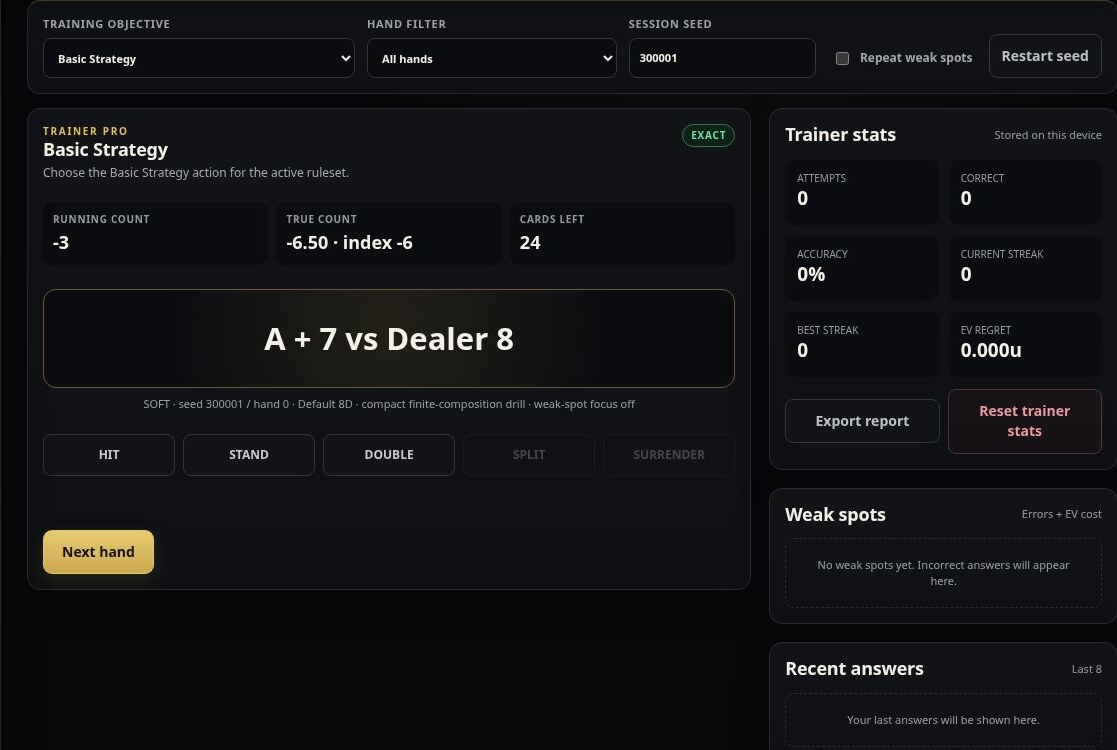
Choose Basic Strategy, True Count deviations or exact-composition FULL EV practice.
Separates default rules knowledge, index decisions and composition-sensitive comparison.
Focus on all hands, hard totals, soft totals, pairs or surrender spots.
Targets one decision family instead of relying on random repetition alone.
Restart the same generated sequence from a known seed.
Makes a difficult drill reproducible for review or bug reporting.
FULL EV drills reveal the complete remaining A–10 composition before an answer is scored.
Binds the visible exercise to the exact state evaluated by the production engine.
Enables only actions supported as legal for the generated hand and ruleset.
Reinforces the table contract as well as the mathematical answer.
Compares your answer with the strongest supported action and expresses the difference in wager units.
Some wrong answers cost much more than others. This helps you decide what to practise first.
Stores groups of recurring mistakes and can repeat the patterns causing the most trouble.
Turns past mistakes into targeted practice.
Tracks attempts, correct answers, accuracy, streaks, total regret, recent answers and JSON export.
Makes progress and recurring errors reviewable on the device.
Read the practical guide for this tool →
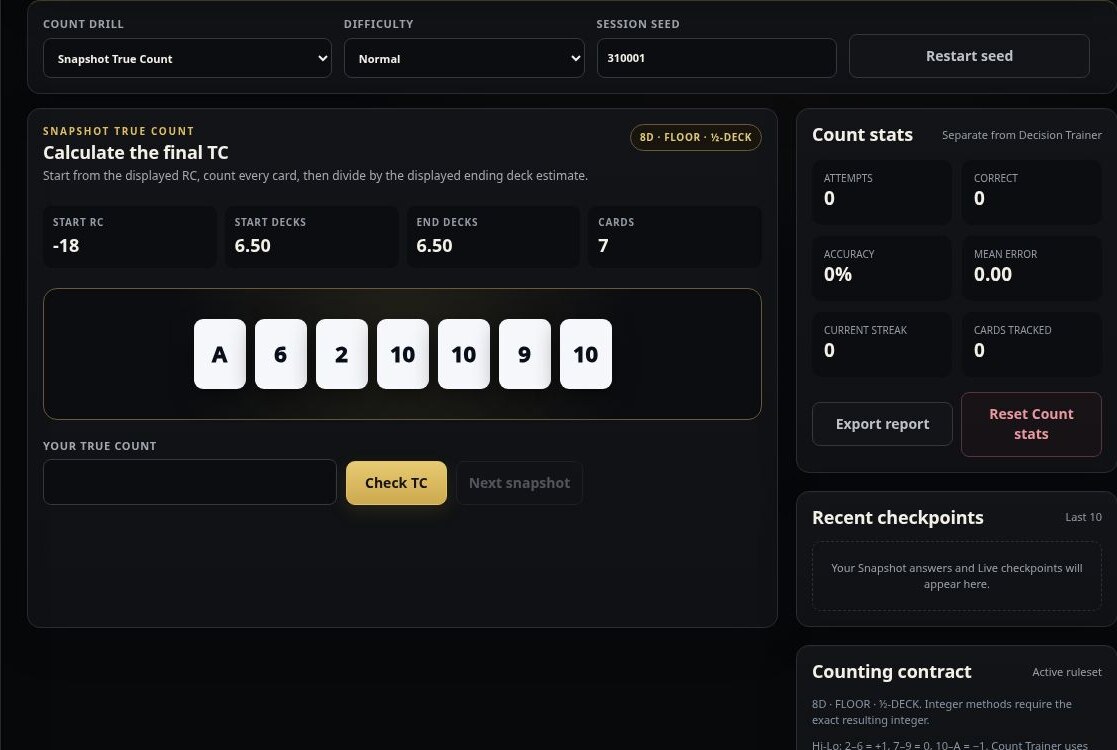
Shows a starting RC, deck estimates and a visible group of cards, then asks for the final TC.
Practises the complete RC-to-TC calculation with a transparent answer breakdown.
Flashes physical cards without replacement, hides them and pauses at automatic or manual checkpoints.
Trains count retention under time pressure rather than only static arithmetic.
Beginner, Normal, Hard and Expert vary the workload and starting depth.
Allows speed and shoe depth to increase as accuracy improves.
Slow, Normal, Fast, Expert and 200–5,000 ms custom card speed are available in Live Shoe.
Controls pressure without changing the underlying Hi-Lo contract.
Start, pause, resume, request a checkpoint, continue and end the shoe.
Makes long drills manageable and supports deliberate self-testing.
Shows card delta, actual/final RC, raw TC, index decks and the expected index TC.
Identifies whether an error came from counting, deck estimation or conversion.
Tracks attempts, accuracy, mean error, streak, cards tracked, recent checkpoints and JSON export.
Keeps counting performance isolated from Decision Trainer and Analyzer history.
Settles wins, losses, pushes, break-even results and individual Split hands in units and optional money.
Separates whether a hand won from whether the earlier decision was mathematically sound.
Tracks rounds, win rate, net units, P&L, decisions, deviations, splits, average TC and result counts.
Creates a compact record of both play outcomes and analytical decisions.
Adds total wagered, average base bet, maximum settled drawdown and Under/Match/Over recommendation counts.
Shows actual exposure and whether bet sizing followed the active plan.
Keeps the current or last completed event ledger with batch and whole-round correction controls.
Makes card and action corrections visible instead of silently editing totals.
Keeps a checked recovery copy on your device and allows one analyzer tab per account in the same browser profile.
A second analyzer tab waits until you close the first and reload, protecting saved progress.
Download your history, settings and training progress from Account, even after access ends. With active access, restore a backup through Local data in the analyzer.
Review the file before restoring. A copy from before the restore stays available to download. Data remains local to your device.
Exports a detailed JSON record and a simpler decision CSV with rules, strategy and shoe history.
You can review or debug the session outside the app while keeping the calculation trail attached.
Reset Shoe preserves session statistics; Reset Session preserves the shoe and count.
Avoids destroying unrelated state when only one layer needs to restart.
TECHNICAL REFERENCE
The complete list is still here, but it stays out of the way until you open the category you need.
AUTO · FAST · FULL
Your hand · Dealer · Other players
Hit · Stand · Double · Split/Resplit · Surrender · Cash Out
Undo · Undo 5 · Undo whole round · Restore previous round
Next round · Reset shoe · Reset session · Save session
Bankroll · Table minimum · Table maximum · Smallest bet step
EUR · USD · GBP · Units
Cautious (¼ Kelly) · Balanced (½ Kelly) · Aggressive (¾ Kelly), each confidence-scaled
50% · 55% · 60% · 65% · 70% · 75% · 80% · 85% dealt
500 · 1,000 · 2,000 paths
Skip the round · Force table minimum for comparison only
Basic Strategy · True Count deviations · Exact composition EV
All · Hard · Soft · Pairs · Surrender
Numeric session seed · Restart seed
Repeat weak spots on/off
Export report · Reset Trainer stats
Snapshot True Count · Live Shoe
Beginner · Normal · Hard · Expert
Slow 2.00 s · Normal 1.25 s · Fast 0.75 s · Expert 0.40 s · Custom 200–5,000 ms
Numeric session seed · Restart seed
Start · Pause/Resume · Check TC now · Continue · End shoe
Export report · Reset Count stats
6 · 8
50% through 85% in 5% steps
S17 · H17
Ace peek only · Peek A/10 · ENHC
All bets lose · Original bet only (OBO)
None · Late
3:2 · 6:5
Any two cards · Hard 9–11 · Hard 10–11
2 · 3 · 4
Floor · Truncate · Round · Exact
Nearest half deck · Exact cards remaining
Core I18/Fab Four · Extended sourced rows · Complete when an exact rule-matched certified pack exists
DAS · Split Aces · Resplit Aces · Hit Split Aces · Double Split Aces
Off/on · Total returned with stake included · Net profit with stake returned separately
Name · Save · Load · Delete
1 = Ace · 2–9 = matching rank · 0 = 10
Delete or Numpad . = Your hand · − = Dealer · + = Other players
↑ or H = Hit · ↓ or S = Stand · ← or D = Double · → = Split/Resplit
Ctrl + Shift = Surrender · C = Cash Out · Numpad Enter = Next round
Backspace or Ctrl/Cmd + Z = Undo or confirmed previous-round restore
Save session · Clear saved sessions
Schema-6 JSON · Decisions CSV
Decision Trainer JSON · Count Trainer JSON
Validated recovery · Last-known-good journal · One analyzer tab per account
CURRENT PRODUCT BOUNDARY
Advantage Count models one observed player seat plus the dealer. Cards are entered manually. It does not connect to a casino, read a table screen, place wagers or know unseen future cards. Cash Out and other occupied seats remain outside the bankroll forecast, and unsupported strategy/rules combinations fail closed.